
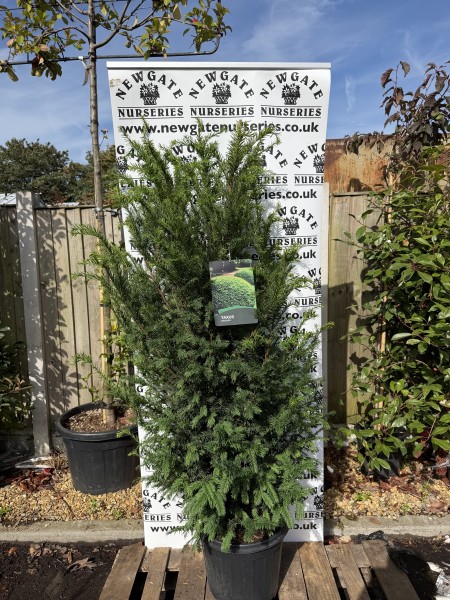
125-150cm (C20)
£69.99
Nothing else does what yew does. It holds sharper clipped lines than any hedge you can buy, stays immaculate on a single annual trim, grows in shade that defeats everything else — and it regenerates from old bare wood, which is why 300-year-old yew hedges still look perfect and why an inherited, overgrown yew can be cut hard back and renewed. Plant it well and it’s a permanent feature of the garden, not a decade’s stopgap.
WHICH SIZE SHOULD I CHOOSE?
Yew is a once-in-a-lifetime planting, so match the size to your patience: established plants grow a steady 20–30cm a year, so from mid-sized stock you’ll have a respectable formal hedge within four or five seasons, while larger plants give structure immediately. Plant 3 per metre, or 2 per metre with larger plants.
All heights are measured from the top of the pot to the top of the plant.
GROWING CONDITIONS
Sun or deep shade, in any soil that drains — the one thing yew will not forgive is waterlogged roots. On heavy ground, plant slightly proud on a ridge of improved soil. One trim a year, late summer ideally, holds the line indefinitely. Note that yew is toxic if eaten — as it has been in every garden it’s graced for centuries — so keep it away from grazing animals, and keep clippings out of paddocks.
PLANTING & AFTERCARE
Take the planting seriously — it’s the foundation of a hedge that will outlast us all. A generous trench with the base well broken up, bone meal through the backfill, rootballs level and firmed, and a thorough soak. Water deeply through the first two summers, feed each spring, and be patient in year one: yew builds roots before it builds top growth, then gets on with it.
GROWN AT NEWGATE
Grown on outdoors at our nursery in Whitestake, Lancashire. Come and pick your plants off the beds seven days a week — with yew especially, choosing well-matched, well-furnished plants at the start is worth the trip. UK-wide delivery quoted at checkout.
The classic English formal hedge: deep green, fine-textured, clipping to razor-sharp lines with one trim a year — and quicker than its reputation at 20–30cm a year once established. Thrives in sun or deep shade. A hedge you plant once, for good. Choose your size below; plant 3 per metre.
Not sure how many you need? Use our hedge calculator or call 01772 612336.
| Weight | 10 kg |
|---|---|
| Dimensions | 30 × 30 × 100 cm |
| Colour | 125-150cm (C20) |